
-
Thank you for visiting HeavyEquipmentForums.com! Our objective is to provide industry professionals a place to gather to exchange questions, answers and ideas. We welcome you to register using the "Register" icon at the top of the page. We'd appreciate any help you can offer in spreading the word of our new site. The more members that join, the bigger resource for all to enjoy. Thank you!
You are using an out of date browser. It may not display this or other websites correctly.
You should upgrade or use an alternative browser.
You should upgrade or use an alternative browser.
what is a spacer plate engine?
- Thread starter qball
- Start date


http://www.patentstorm.us/patents/4211205/description.html
This invention relates to a laminated spacer plate for engines, pumps, compressors and the like and a method for making the spacer plate from a plurality of superimposed sheets.
A spacer plate may be employed between the block and head of an internal combustion engine to prevent any hairline cracks from occurring in the block upon operation of the engine. In particular, the relatively high gas pressures developed in adiesel engine, for example, create forces which must be fully absorbed by the block. Prior to the advent of the spacer plate, a counterbore was formed in the block to accommodate a support flange of a cylinder liner and the head was secured directly tothe block. Due to the aforementioned gas pressures and resulting forces imposed on the block, hairline cracks were occassionally developed in the area of the counterbore.
The utilization of a spacer plate between the head and block, with the spacer plate having a thickness substantially equaling the thickness of the support flange of the cylinder liner, has virtually eliminated this cracking problem. However, thespacer plate has heretofore been fabricated as a one-piece member having a thickness in the range of about 11.1125 mm. When the steel stock comprising the spacer plate is subjected to a standard stamping operation to form the various water and oildirector ports and bolt holes therethrough, a subsequent grinding operation is required to eliminate the relatively large "roll-over" formed at the entrance side for the punch or male die forming each opening and hole.
In addition, the liner bores must be precisely formed through the plate by additional stamping and machining operations, due to the close proximity of the previously formed bolt holes and director ports thereto. In addition, the somewhatirregular inlet and exhaust slots normally require a separate flame-cutting operation to form them through the spacer plate. Those skilled in the arts relating hereto will further appreciate that difficulty is oftentimes encountered to hold themachining tolerances within prescribed requirements to provide flat surfaces on the plate to insure efficient clamping and sealing thereof between standard head gaskets disposed on either side thereof. A typical one-piece spacer plate of this type isdisclosed in U.S. Pat. No. 3,396,711, issued on Aug. 13, 1968 to C. N. Fangman et al. and assigned to the assignee of this application.
This invention relates to a laminated spacer plate for engines, pumps, compressors and the like and a method for making the spacer plate from a plurality of superimposed sheets.
A spacer plate may be employed between the block and head of an internal combustion engine to prevent any hairline cracks from occurring in the block upon operation of the engine. In particular, the relatively high gas pressures developed in adiesel engine, for example, create forces which must be fully absorbed by the block. Prior to the advent of the spacer plate, a counterbore was formed in the block to accommodate a support flange of a cylinder liner and the head was secured directly tothe block. Due to the aforementioned gas pressures and resulting forces imposed on the block, hairline cracks were occassionally developed in the area of the counterbore.
The utilization of a spacer plate between the head and block, with the spacer plate having a thickness substantially equaling the thickness of the support flange of the cylinder liner, has virtually eliminated this cracking problem. However, thespacer plate has heretofore been fabricated as a one-piece member having a thickness in the range of about 11.1125 mm. When the steel stock comprising the spacer plate is subjected to a standard stamping operation to form the various water and oildirector ports and bolt holes therethrough, a subsequent grinding operation is required to eliminate the relatively large "roll-over" formed at the entrance side for the punch or male die forming each opening and hole.
In addition, the liner bores must be precisely formed through the plate by additional stamping and machining operations, due to the close proximity of the previously formed bolt holes and director ports thereto. In addition, the somewhatirregular inlet and exhaust slots normally require a separate flame-cutting operation to form them through the spacer plate. Those skilled in the arts relating hereto will further appreciate that difficulty is oftentimes encountered to hold themachining tolerances within prescribed requirements to provide flat surfaces on the plate to insure efficient clamping and sealing thereof between standard head gaskets disposed on either side thereof. A typical one-piece spacer plate of this type isdisclosed in U.S. Pat. No. 3,396,711, issued on Aug. 13, 1968 to C. N. Fangman et al. and assigned to the assignee of this application.

DPete
Senior Member
Long story short the older engines had the counter bore for the liners machined into the block, the liners sat on a thin ledge and that ledge was prone to cracking from over tightening head bolts or corrosion and normal heat- cool cycles. Once a crack occurd the liner would sink creating head gasket problems. In my experience the compression would leak into the water jacket pressureizing the system and blow coolant out the relief valve. If cracking or erosion occured the counter bore had to be machined out and a new insert installed. On the spacer plate engines the block is flat and the plate creates the counter bore for the liners to sit in. If the block becomes uneven from normal heat cool cycles one can machine the top of the block in one operation uposed to fooling with 6 counter bores. There is also more material where the liners sit as it has not been machined out like the older counter bore blocks. Clear as mud I bet 
george39
Member
Thanks for the explantion, I have always wondered what the term meant

ScottAR
Senior Member
Good read. Thanks guys...

RocksnRoses
Senior Member
- Joined
- Jun 14, 2008
- Messages
- 770
- Location
- South Australia
- Occupation
- Owner operater crushing & contracting business
Am I correct in thinking, that only Caterpillar had engines with the spacer plate between the head and the block, as I do not know of any other engines with it. We had a 950E Wheel loader that had a cracked liner and it had a spacer plate engine. I wondered at the time, why they needed this plate with an extra head gasket, to me it was just more places to leak, but the previous explanations have covered that very well and I can see the reasoning there. Can I assume then, that this was the reason for Caterpillar using the spacer plate, too overcome the cracking and machining problems, as the other engine manufacturers do not seem to have any problems without it.
Rn'R.
Rn'R.

Aussie Nick
Well-Known Member
Crikey!!!!
Sounds like one more cracking question on top of the original one. I don't know the answer Rocky but i bet you will get a cracking good answer from someone.
Sounds like one more cracking question on top of the original one. I don't know the answer Rocky but i bet you will get a cracking good answer from someone.

John C.
Senior Member
The issues as I understand them from a few years of working and rebuilding D8 and D9 engines was that the blocks were essentially the same as first designed in the fifties and sixties. The manufacturers kept bumping up the horsepower to meet the competition instead of designing a new engine to handle the extra ponies.
The resulting problem that I saw was cracked or sunken counterbores due to liner slap and vibration that occured with the higher firing pressures. The addition of the spacer plate did away with the counterbores allowing for more mass to absorb the vibration and pounding happening in the liners. I've been out of that long enough now that I don't know if Cat still uses the spacer plates in the C series engines. Perhaps someone could enlighten use.
It is funny that I saw exactly the same counter bore problems on Cummins engines by haven't seen what they have done to fix the problem. Hopefully a Cummins wrench could let us know.
Great Thread!
The resulting problem that I saw was cracked or sunken counterbores due to liner slap and vibration that occured with the higher firing pressures. The addition of the spacer plate did away with the counterbores allowing for more mass to absorb the vibration and pounding happening in the liners. I've been out of that long enough now that I don't know if Cat still uses the spacer plates in the C series engines. Perhaps someone could enlighten use.
It is funny that I saw exactly the same counter bore problems on Cummins engines by haven't seen what they have done to fix the problem. Hopefully a Cummins wrench could let us know.
Great Thread!
tctractors
Senior Member
Spacer plate
The first engine I worked on with a spacer plate, was on a J.Deere small tracked loader 10-10 with a lanze engine (German) the liners sat into counter bores machined into the spacer plate, Italian engines used this system of cylinder liner mounting also, (Renault), I often wonder why CAT sit the liner on the Cast face of the Block instead of making the counter bores in the spacer plate like other engine builders, as the steel/alloy used in spacer plates is of superior material than the cast block, plus any damage to the counter bore would only need a new plate fitting???? but CAT do some odd things, the Cylinder kit thing bothers me, the liner comes with a piston and rod all ready to poke in the hole, I prefer to Fit the liner without seals into the block to check the fit and hight before poking all the other bit's in.
tctractors.
p.s. Renault Trucks often have Mack Badges on them around my location .
The first engine I worked on with a spacer plate, was on a J.Deere small tracked loader 10-10 with a lanze engine (German) the liners sat into counter bores machined into the spacer plate, Italian engines used this system of cylinder liner mounting also, (Renault), I often wonder why CAT sit the liner on the Cast face of the Block instead of making the counter bores in the spacer plate like other engine builders, as the steel/alloy used in spacer plates is of superior material than the cast block, plus any damage to the counter bore would only need a new plate fitting???? but CAT do some odd things, the Cylinder kit thing bothers me, the liner comes with a piston and rod all ready to poke in the hole, I prefer to Fit the liner without seals into the block to check the fit and hight before poking all the other bit's in.
tctractors.
p.s. Renault Trucks often have Mack Badges on them around my location .
RolyD8k
Well-Known Member
- Joined
- Apr 24, 2008
- Messages
- 52
- Location
- south east of England
- Occupation
- farmer & earthmoving contractor
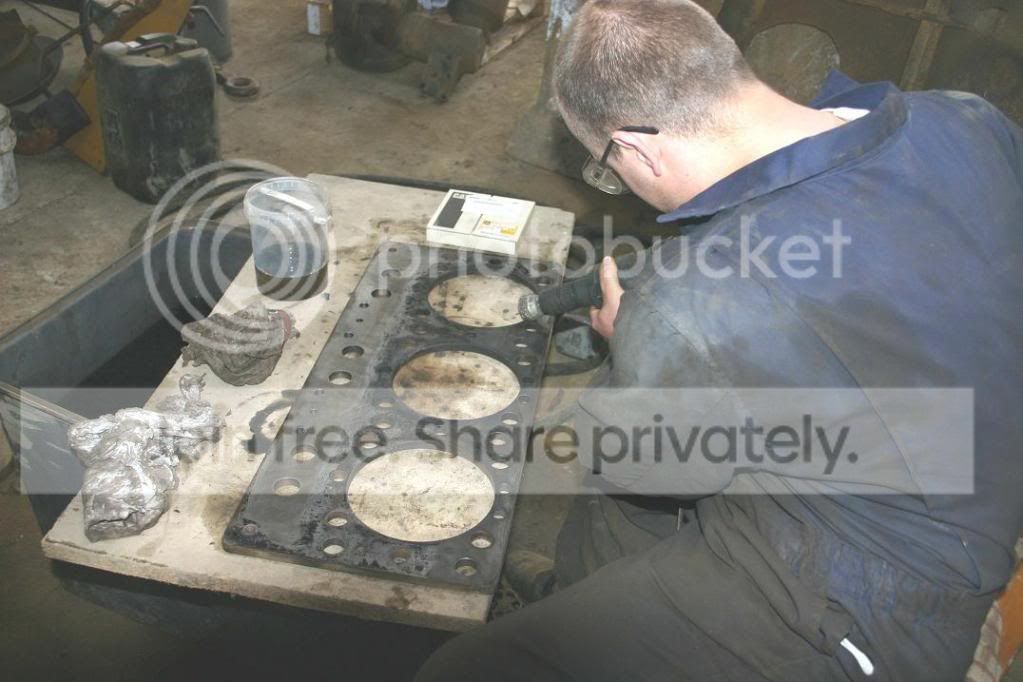
spacer-plate engine
The later D8k,s have spacer-plate,s on there D342 engine,the
liner sits on top of the block and the spacer-plate sits around
it,we had to cut the block because of cracking and fit a
stainless steel shim,but we have had a lot less trouble with the
spacer-plate engine than the engine without it.
RB
Cutting the counter-bore

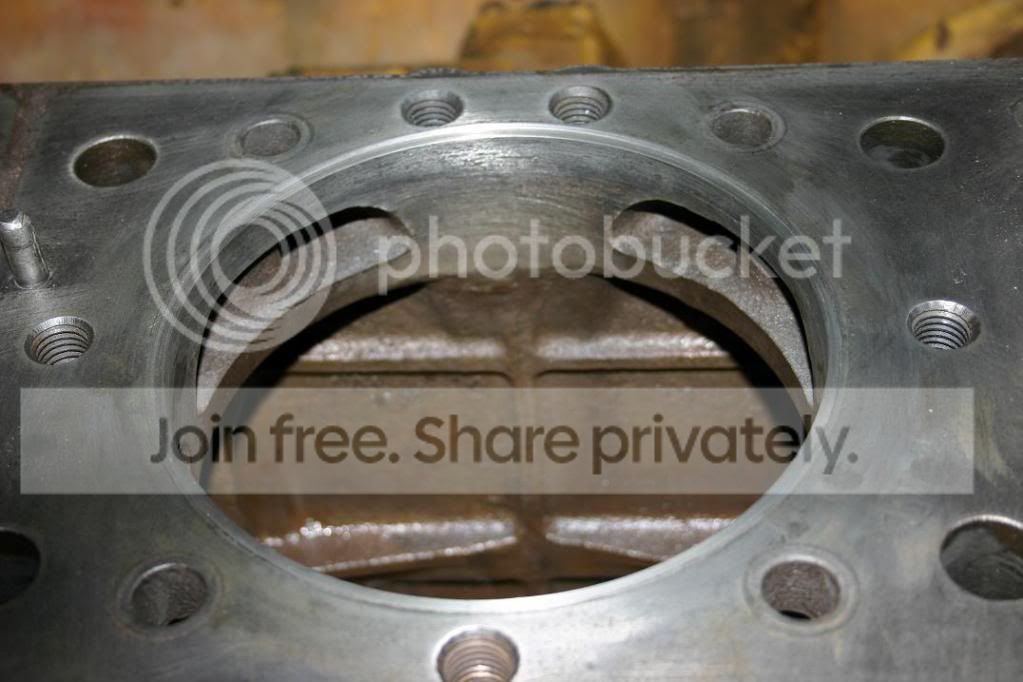

The spacer-plate
The later D8k,s have spacer-plate,s on there D342 engine,the
liner sits on top of the block and the spacer-plate sits around
it,we had to cut the block because of cracking and fit a
stainless steel shim,but we have had a lot less trouble with the
spacer-plate engine than the engine without it.
RB
Cutting the counter-bore
The spacer-plate
Last edited:
DPete
Senior Member
We had counter bore problems with 14A's as they aged I think they were 185 HP and they were naturally asperated. I don't think the problem was related to horsepower as much as poor design and over tightening head bolts. We put alot of head gaskets before we found the real problem which was low liners due to the counter bore cracking. Correct liner pertrusion is critical on those engines.The issues as I understand them from a few years of working and rebuilding D8 and D9 engines was that the blocks were essentially the same as first designed in the fifties and sixties. The manufacturers kept bumping up the horsepower to meet the competition instead of designing a new engine to handle the extra ponies.
The resulting problem that I saw was cracked or sunken counterbores due to liner slap and vibration that occured with the higher firing pressures. The addition of the spacer plate did away with the counterbores allowing for more mass to absorb the vibration and pounding happening in the liners. I've been out of that long enough now that I don't know if Cat still uses the spacer plates in the C series engines. Perhaps someone could enlighten use.
It is funny that I saw exactly the same counter bore problems on Cummins engines by haven't seen what they have done to fix the problem. Hopefully a Cummins wrench could let us know.
Great Thread!
Last edited:
looking for d8k for sell
dears guys :
we are looking for more than 3 d8k of ( 1978 to 1982 ) they had this specification's ( spacer plat engine - single or multi rippers - original pant - clean machine - good undercarriage - canopy cap ) we are ready to pay commission for him , please sand me the pictures ( [email protected]) ,. for more see the link as in
http://www.machinerystock.com/member/view_machine_detail.php?stock=6307
thanks guys
dears guys :
we are looking for more than 3 d8k of ( 1978 to 1982 ) they had this specification's ( spacer plat engine - single or multi rippers - original pant - clean machine - good undercarriage - canopy cap ) we are ready to pay commission for him , please sand me the pictures ( [email protected]) ,. for more see the link as in
http://www.machinerystock.com/member/view_machine_detail.php?stock=6307
thanks guys

Phil
Senior Member
- Joined
- May 2, 2005
- Messages
- 1,067
- Location
- Southeastern Ontario
- Occupation
- retired operator and mechanic
Years ago we had a bare D8H block sent to a machine shop, and inserts installed to repair the counterbores. It wasn't too many years later the problem came back for whatever reason. I remember that Cat had a larger 2-step insert that actually went out into the stud holes, so there ended being notches re-machined for the studs. Those blocks (the high horse engine), got pretty hard to find. There was a case of someone who actually machined the deck of a block down to the correct height for a spacer plate, before realizing it would not work.
I've heard that the later spacer plate engine was not problem free. Is it the liners that get working in the bore?? Phil
I've heard that the later spacer plate engine was not problem free. Is it the liners that get working in the bore?? Phil
OC(Outside Cat)
Member
The early D8K's didn't have the spacer plate, as described, the liner would work down in the block and lose the liner protrusion, then they would allow compression in the cooling system and push water out the overflow. If you didn't check the water level everyday, it would get low and cause the cyl. head to crack due to lack of coolant.
OC
OC
surfer-joe
Senior Member
I did several block repairs on D8 and D9 engines when the kits first became available. We had a special tool that was used by hand to machine the liner bores. It had to be bolted down and torqued, and the depth of the cut had to be measured and rechecked often so as to make sure all cracks were cut out and the recommended thickness of liner shims was not exceeded. Any block that exceeded the recommended specifications was to be rejected and the customer had to buy a new block. But we did cheat a little if the shims pack was only 2-3 thousandths out of spec. We merely added enough shims to get the correct liner height.
All that I did were in-frame in a metal shed that was twenty degrees colder than outside, which was about zero F. One of the coldest winters I have worked anywhere, and at over 8000 feet elevation. I sure was glad to see spring arrive!
The spacer plate kits were a tempory fix on the older models while CAT was designing the first 3400 series engines. The plates were made from a solid piece of steel, not laminates. Some mechanics made the mistake of applying gasket adhesive to both sides of the head and spacer plate gaskets, with the result that many heads and plates were ruined when they had to be removed again. The plates usually bent, and one had to stick two long pry bars into the exhaust ports on the head to pry it off. That sometimes cracked the casting internally.
Before the kits became available, CAT tried sending out new liners that had to be machined before installation, not many dealers had the required machines to do that, and thus the shim kits and the smaller hand operated tooling became available.
All that I did were in-frame in a metal shed that was twenty degrees colder than outside, which was about zero F. One of the coldest winters I have worked anywhere, and at over 8000 feet elevation. I sure was glad to see spring arrive!
The spacer plate kits were a tempory fix on the older models while CAT was designing the first 3400 series engines. The plates were made from a solid piece of steel, not laminates. Some mechanics made the mistake of applying gasket adhesive to both sides of the head and spacer plate gaskets, with the result that many heads and plates were ruined when they had to be removed again. The plates usually bent, and one had to stick two long pry bars into the exhaust ports on the head to pry it off. That sometimes cracked the casting internally.
Before the kits became available, CAT tried sending out new liners that had to be machined before installation, not many dealers had the required machines to do that, and thus the shim kits and the smaller hand operated tooling became available.
Phil
Senior Member
- Joined
- May 2, 2005
- Messages
- 1,067
- Location
- Southeastern Ontario
- Occupation
- retired operator and mechanic
Surfer, I've read there were different problems with the spacer plate engine, over on ACMOC, although no where near as bad as the earlier engine. Can you go into more detail on the use of gasket sealer and the problem it caused? I can't quite understand the part about the spacer plate bending and getting stuck on the cylinder head. Thanks, Phil
Last edited: