
No once the lock and lube is stuck on it. To get the coupler off with out damage to the coupler.Heat..... or replace.... they're cheap enough...... (the zerk)

-
Thank you for visiting HeavyEquipmentForums.com! Our objective is to provide industry professionals a place to gather to exchange questions, answers and ideas. We welcome you to register using the "Register" icon at the top of the page. We'd appreciate any help you can offer in spreading the word of our new site. The more members that join, the bigger resource for all to enjoy. Thank you!
You are using an out of date browser. It may not display this or other websites correctly.
You should upgrade or use an alternative browser.
You should upgrade or use an alternative browser.
Damn you, Milwaukee
- Thread starter Shimmy1
- Start date

colson04
Senior Member
Eh, that can be tough. I usually lean the lock n lube at and angle and eventually it'll break the seal enough to let the pressure squirt off to the side. Yes, that risks ruining the seal inside the lock n lube. Other options are buy the lock n lube pressure release system for your grease gun, or use a wrench to crack the line open to release pressure.No once the lock and lube is stuck on it. To get the coupler off with out damage to the coupler.
Unscrew the hose, or they have a pressure relief bypass available.That's what they tell me but how should you deal with a plugged fitting
It's rare I come across plugged fittings aside from new to me equipment that some I swear last saw grease in the 80s.

Deere500a
Senior Member
The zerk doesn't take Grease adjust the angle or tap pin with a hammer but times remove zerk some PB blaster in the hole dry ol grease need to be moisted & reinstall no go replace zerk & get a Milwaukee
Shimmy1
Senior Member
I cannot get behind a Milwaukee grease gun. I have one, but it only gets used when it's cold because the batteries last longer than my Lincoln 20V. I think it's rather clumsy, and takes steady pressure on the plunger when it's cold to pump.
As far as the lockNleak, no thanks. I don't know how some guys love them, and some hate, but they are definitely not for me. Tried 2 about 8 years ago. One lasted about 3 tubes, and not once had been stuck on a zerk. The second leaked after the second zerk. I use the standard Lubrimatic couplers. Buy them a dozen at a time, usually get through the season with that. I am considering buying about 1000 new fittings and swapping every single zerk in the fleet, and see if that stops the coupler issues.
As far as the lockNleak, no thanks. I don't know how some guys love them, and some hate, but they are definitely not for me. Tried 2 about 8 years ago. One lasted about 3 tubes, and not once had been stuck on a zerk. The second leaked after the second zerk. I use the standard Lubrimatic couplers. Buy them a dozen at a time, usually get through the season with that. I am considering buying about 1000 new fittings and swapping every single zerk in the fleet, and see if that stops the coupler issues.

hvy 1ton
Senior Member
That's what they tell me but how should you deal with a plugged fitting

Introducing The LockNLube Pressure Return Valve! A must-have for your
LockNLube's mission has always been to END GREASING FRUSTRATION. We that in mind, we are so excited to bring you this innovative solution to a persistent issue that every person who uses a cordless battery grease gun deals with. We have all had that experience of going to grease a Zerk and...
 locknlube.com

materthegreater
Senior Member
Does anyone have a Milwaukee laser level?
JLarson
Senior Member
I picked up a green 3 line M12 laser a little while back, good laser, it's nice to just grab another M12 battery and not get new AA's or whatever if you're doing a lot of work.
Diesel Dave
Senior Member


That's hilarious!

Truck Shop
Senior Member
That is hilarious yes, in reality--I hate a tool that works over my wrist with only a pistol
grip to control torque. I suppose there is another screw in handle?
grip to control torque. I suppose there is another screw in handle?

Welder Dave
Senior Member
Big heavy duty drills are scary no matter how many handles they have. A drill bit jams and they still try to rip your arm off. Hand held post hole augers are bad too.
we had one of those impacts. The modern 3/8 will wayy out do it.That's hilarious!
materthegreater
Senior Member
Who has one of these grinders? I like the higher rpms vs the 4-1/2"-5" version. Lower rpms than plug in grinders is what has prevented me from buying a battery one so far.
Welder Dave
Senior Member
9000 RPM's is good for a 6" grinder. 5" are usually 10,000 RPM and 7" are usually 6000 RPM. There are a few exceptions but should be a decent grinder. Too bad there wasn't theft forum where thieves could give reviews of the best tools to cut steel and other materials in a hurry. I think cordless grinders and Sawzalls are the greatest tools ever invented for thieves.
PeterG
Senior Member
I have two Milwaukee 18V small grinders that I mostly use for business with Masonry diamond blades. I also use them for cutting, grinding, and deburring metal. The smallest one is great. It's a lightweight one handed tool to easily do deburring, easy cutting, and cleaning off corrosion. I usually have a smaller 4"-5 dia disc on it. The slightly bigger one feels heavy enough for two hands, and has some serious power and feels way more dangerous. Best for cutting thicker metal, and grinding off a lot of material. It's a tool you get out the gloves, hearing protection, eye protection, mask etc. Both of them have plenty of power. With an XC6 battery you can get a lot of grinding done.
Truck Shop
Senior Member
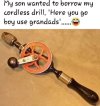
.
Welder Dave
Senior Member
Or a brace and bit. I took all the steel floor plates over electrical junctions out of a huge building that was being demolished in the early 80's. 4 screws in each one. Didn't have a cordless drill so used an old brace for drilling wood with a screwdriver bit in it. Same idea as a speed handle for sockets. The plates were about 10" dia. and 3/16" thick so well worth the effort to take them out.
westerner
Senior Member
Where are they now?Or a brace and bit. I took all the steel floor plates over electrical junctions out of a huge building that was being demolished in the early 80's. 4 screws in each one. Didn't have a cordless drill so used an old brace for drilling wood with a screwdriver bit in it. Same idea as a speed handle for sockets. The plates were about 10" dia. and 3/16" thick so well worth the effort to take them out.
Welder Dave
Senior Member
I used some to make a counterweight.