To mockingly quote myself, I really am impressed with the amount of power a li-ion battery pack can produce and I wanted to explain it a bit more so folks here can make up their own mind about using them or not.
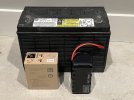
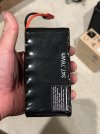
Here's a pic of a Cat Group 31 lead-acid battery with a military issue Brentronics BB-2590 lithium ion radio battery and a custom lithium ion battery pack I use in my prototypes. The BB-2590 is both 12v/24v while my custom li-ion is only 24v.
View attachment 359602View attachment 359603
The Cat 31 holds 100amps at 12v so 1,200 Watt-Hours (Wh) which means it more/less can provide 1,200 watts of continuous power for an hour before being completely dead. But remember that you can only discharge a typical lead acid battery to roughly 50% before it starts to sulphate (for a starting battery, not a deep cycle or AGM) so you only get ~600 Wh of usable capacity in a 55lb box with about 0.5 cubic foot (ft3) volume.
The BB-2590 is rated at 298 Wh, weighs 3.1lbs and is 0.03 ft3 in volume.
My custom li-ion pack has 348 Wh, weighs 3.2 lbs and occupies 0.024 ft3.
You can easily discharge a typical lithium battery down to 5% ( or 95% depth of discharge) so you're getting pretty much all the capacity it has to offer.
So when you compare equivalent available energy capacities in typical use, a flooded lead acid battery weighs 10x more and occupies 10x the space of an equivalent lithium battery.
But the truly amazing aspect of lithium ion batteries is you can adjust their chemistries to be either extremely energy dense (like my custom packs for 4 hours of discharge) or extremely fast discharge (like certain lithium polymer cells found in the jump packs we're discussing above). If my custom pack was built with those high-discharge cells, that small pack could dump all 348 Watt-hours of capacity in only a couple mins as opposed to over a full hour. That translates to 10,440 watts of continuous power draw for that little pack for two mins. Compare that to the Cat group 31 that is rated to dump a max of 750 amps (CCA) at ~12v or ~9,000 watts of power. Granted the Cat batt can do this for 4 mins instead of just two for the li-ion but it's still impressive the li-ion can out-sprint the Cat for even a couple mins.
So bottom line: a piddly lithium battery can produce more cranking power than a lead acid battery while still being only 10% the weight and size.
Hope folks find this informative.