• Thank you for visiting HeavyEquipmentForums.com! Our objective is to provide industry professionals a place to gather to exchange questions, answers and ideas. We welcome you to register using the "Register" icon at the top of the page. We'd appreciate any help you can offer in spreading the word of our new site. The more members that join, the bigger resource for all to enjoy. Thank you!

Pond overflow options

materthegreater

Senior Member
Joined
Jul 25, 2012
Messages
2,094
Location
VT
What are preferred options for an overflow for a small pond? Approx 50' diameter, maybe 6' deep. It was built on a slope years ago so there is a dam on the lower side with a steel culvert at the bottom of the dam that was blocked off unless the pond needed to be drained for some reason. The customer wants me to replace it with something more modern, presumably with some sort of stand pipe so excess water doesn't spill over the dam.
 

MG84

Senior Member
Joined
Jan 6, 2023
Messages
1,397
Location
Virginia
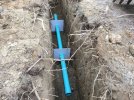
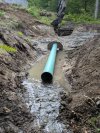
Vertical stand pipe using either SDR-35 or SCH40 PVC, sized accordingly to acreage that drains into it, not necessarily pond size. 4" minimum diameter if its in open country, 6-8" minimum if its likely to get debris, could take even large if it has a lot of water flowing through it. You'll need to drain the pond partially to install it, we do quite a few of these on old ponds that are leaking. If doing it with the pond full, pump or siphon the pond down about 3-4' (you can get by with less, but your over flow ends up real close to the bank. Start out as far as you can without letting water get in to your excavation, trench straight down 3-4' then carry a 1/4" per foot grade on your trench all the way through the dam. If you want to drain the pond completely just trench through the dam, same height and location as the original pipe. Along with a vertical stand pipe every pond should also have an earthen emergency overflow (flat broad based ditch, seeded down in KY31 Fescue or the like). Grade of emergency overflow should be 8-12" above water level on a small pond. Below are some pics are of a pond with an old metal overflow that was leaking that we replaced.

Dug through old pipe, poured concrete plug and filled old stand pipe:

IMG_0896sm.JPG

New vertical stand pipe installed:
IMG_0898sm.JPG

Anti-siphon collars:
IMG_0907sm.JPG
 

MG84

Senior Member
Joined
Jan 6, 2023
Messages
1,397
Location
Virginia
Another small pond we recently redid, trenched through the dam, drained, and dredge all the muck, reshaped dam and new 8" stand pipe. This one is closer to the bank than I like, but customer wanted to be able to reach it with a rake to remove debris. Earthen emergency overflow is flat area directly on the right side of dam. Wish I had some closer pics but this is it:
IMG_0617sm.JPG
 

redneckracin

Senior Member
Joined
May 19, 2010
Messages
608
Location
Western PA
Occupation
Civil Engineer
I'll second the sizing the pipe on the drainage area and not the pond size. Either way, there should be an emergency spill way at least 1' lower than the breast height of the pond/dam to prevent a catastrophic failure incase the pipe cant handle the flow.
 

materthegreater

Senior Member
Joined
Jul 25, 2012
Messages
2,094
Location
VT
Thanks for all the input. The customer ordered a gasketed concrete elbow and pipe. 10" I think. I'll find out for sure when things dry out enough for me to go back and do the work.
 

materthegreater

Senior Member
Joined
Jul 25, 2012
Messages
2,094
Location
VT
So it turns out the customer ended up making his own stand pipe base with a 10" gasketed PVC elbow cast in concrete and a 4" drain.

Here it is upside down:
1000009305.jpg

Ready to install
1000009306.jpg

1000009307.jpg

1000009308.jpg
 

CM1995

Administrator
Joined
Jan 21, 2007
Messages
16,056
Location
Alabama
Occupation
Running what I brung and taking what I win
Not being nit-picky but the 10" and 4" pipe is backwards. Bells go uphill on gravity drainage pipe, storm and sanitary. Reason being with the bells laid downhill the lip can catch debris and clog overtime.
 

MG84

Senior Member
Joined
Jan 6, 2023
Messages
1,397
Location
Virginia
Hopefully yall put some anti-seep collars around those pipes? Two pipes close together like that look like a good spot for leakage in the future. Otherwise, looks like it should work fine. Interesting idea on the concrete cast elbow, never seen it done like that before.
 

materthegreater

Senior Member
Joined
Jul 25, 2012
Messages
2,094
Location
VT
Hopefully yall put some anti-seep collars around those pipes? Two pipes close together like that look like a good spot for leakage in the future. Otherwise, looks like it should work fine. Interesting idea on the concrete cast elbow, never seen it done like that before.
Nope, just filled around them with liquefied clay.
 

CM1995

Administrator
Joined
Jan 21, 2007
Messages
16,056
Location
Alabama
Occupation
Running what I brung and taking what I win
Yeah I do like the pre-cast 90. Might just have to use that idea in the future on temp sediment ponds.
 

materthegreater

Senior Member
Joined
Jul 25, 2012
Messages
2,094
Location
VT
Hopefully yall put some anti-seep collars around those pipes? Two pipes close together like that look like a good spot for leakage in the future. Otherwise, looks like it should work fine. Interesting idea on the concrete cast elbow, never seen it done like that before.

Just curious, did you mean anti-seep in your post up above with the pictures where it says anti-siphon? What did you make the collars out of?
 

MG84

Senior Member
Joined
Jan 6, 2023
Messages
1,397
Location
Virginia
Just curious, did you mean anti-seep in your post up above with the pictures where it says anti-siphon? What did you make the collars out of?
Yes I mistyped, meant anti-seep collars. We make them out of 1/2" PVC board, comes in 4x8 sheets from Lowes. It's not cheap but you can get several out of a sheet. For pipes 8-12" we make them 2'x2', cut the hole to fit as tight as possible around the pipe, then seal with silicone. Adjust size accordingly for larger or smaller pipes.
 
Top