• Thank you for visiting HeavyEquipmentForums.com! Our objective is to provide industry professionals a place to gather to exchange questions, answers and ideas. We welcome you to register using the "Register" icon at the top of the page. We'd appreciate any help you can offer in spreading the word of our new site. The more members that join, the bigger resource for all to enjoy. Thank you!

Hydrated lime to dry mud

Welder Dave

Senior Member
Joined
Oct 11, 2014
Messages
18,081
Location
Canada
Wondering if anyone has experience using hydrated lime to dry muddy roads? It looks like it may a good solution to fix a bad part of my driveway but hoping someone has worked with it before and can comment on how will it works.
 

Delmer

Senior Member
Joined
Jan 3, 2013
Messages
8,923
Location
WI
More of an emergency fix. Expensive and short term compared to more rock. Quick lime would be more effective, chemically absorb some water turning it into hydrated lime, so much more concentrated. And heat up nicely at the same time. I have not used it to dry mud, but used plenty in masonry. Depending on what you can get lime for, portland cement is probably as effective for the money. In the old days, quicklime was widely available and cheap.
 

Welder Dave

Senior Member
Joined
Oct 11, 2014
Messages
18,081
Location
Canada
It can be an emergency fix but is also used as an initial soil stabilizer. From what I was reading Quick lime is about 30% more effective. A 4% application with hydrated lime would only require a 3% application with Quick lime. I couldn't find where to buy Quick lime. I did a bunch of looking and some places wanted $16 for 8kg of hydrated lime. I found some at a farm store that was on sale. Reg. $23.99 on for $19.99 till June 10. It comes in 22.5kg (50lb.) bags. They had 27 bags so I bought all of them. It was $567 with tax so not overly expensive. It's suppost to firm up clay soil and make it so water won't saturate it. When I can, I'll see if the gravel pit can bring over some more material to put on top. There's quite a bit of info on the web.
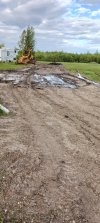
I had it all hand bombed off my truck except for the last 5 bags when I tripped on the corner of the pallet and hit my head on the edge of the box on my truck. I got a nice little gash above my eye and some swelling under my temple. I needed to off load it into my shop before more rain came. A couple bags had rips and it is extremely dusty. I got a mask and goggles to use when I spread it. The area dried up a lot with the high winds the last couple of days. The soup is actually firm enough to walk on now but very wet under the surface. I'll need to add water to mix the lime in. I'm going to try to rip it up enough that I can mix it with the rototiller on the tractor. For a little over $500 I think it's worth experimenting with. I will update my progress.
 

Attachments

  • 20240607_190319.jpg
    20240607_190319.jpg
    1.6 MB · Views: 18
Last edited:

Delmer

Senior Member
Joined
Jan 3, 2013
Messages
8,923
Location
WI
Using it for soil stabilization is common in TX and OK and not much elsewhere from what I've seen. Highly dependent on the chemical composition of the clay you're dealing with, as far as I can tell. It wouldn't be my first choice given your area, and at that price, I'd compare to portland cement price really hard.

Another fun fact about quicklime, firefighting and hazmat training books will often mention "powdered lime" or "lime dust" in context that it's obviously a holdover from quicklime being more common, but they never specify which "lime" and the instructors sure don't have a clue. Kind of like "oily rags", yes, motor oil soaked rags could theoretically spontaneously combust, but rags used to wipe varnish, or clean up oil finishes WILL spontaneously combust quite predictably, but everybody is freaked out about oily rags because they don't know the difference.

 

Welder Dave

Senior Member
Joined
Oct 11, 2014
Messages
18,081
Location
Canada
From what I was reading hydrated lime works with as little as 7% clay. I'm sure I have more than that. Lime apparently firms the soil better than Portland cement with less tendency to crack. Fly ash and cement works better in soils with less clay content. Lime is better known for drying out really wet soil and cement is pretty expensive here. I'll try the hydrated lime and see how it works. I'm sure the gravel pit will have something to put on it as well.
 
Top