
• Thank you for visiting HeavyEquipmentForums.com! Our objective is to provide industry professionals a place to gather to exchange questions, answers and ideas. We welcome you to register using the "Register" icon at the top of the page. We'd appreciate any help you can offer in spreading the word of our new site. The more members that join, the bigger resource for all to enjoy. Thank you!

Bell B25D brake pads wear

ugis

Active Member
Joined
Jun 20, 2021
Messages
39
Location
Europe
So, I have a problem with dumper brake pads wearing out very quickly. It has a dry brake system with brake discs and one brake caliper on each wheel, except the front axle, which has two calipers per wheel.


I bought this machine 1.5 years ago. After a while, I noticed that the pads on the rear axle were completely gone. I bought new OEM pads, cleaned everything up, checked the system, and everything looked fine. But after only about 200–300 hours, the pads were gone again.

The brake discs do not overheat or anything like that. We are not F1 racers, so the brakes are mostly used only while reversing or tipping. The front axle has no issues with pad wear.

The only idea I came up with is the very muddy working conditions.

Is this a common problem with dry brake systems abused by mud, clay, or sand? Any solutions?
 

ohdeereme

Active Member
Joined
Mar 20, 2026
Messages
43
Location
North Carolina
The mud could be an issue but you need to make sure the exhaust brake and retarder system are working correctly. Since the front brakes aren't wearing at all you might want to check the rear and intermediate caliper pistons for not retracting far enough and make sure all the covers are in place on the inside of the wheels. That's the same truck as a Deere 250D if you need to compare some used parts.
 
Joined
May 17, 2026
Messages
15
Location
Anchorage AK, United States
So, I have a problem with dumper brake pads wearing out very quickly. It has a dry brake system with brake discs and one brake caliper on each wheel, except the front axle, which has two calipers per wheel.


I bought this machine 1.5 years ago. After a while, I noticed that the pads on the rear axle were completely gone. I bought new OEM pads, cleaned everything up, checked the system, and everything looked fine. But after only about 200–300 hours, the pads were gone again.

The brake discs do not overheat or anything like that. We are not F1 racers, so the brakes are mostly used only while reversing or tipping. The front axle has no issues with pad wear.

The only idea I came up with is the very muddy working conditions.

Is this a common problem with dry brake systems abused by mud, clay, or sand? Any solutions?
Honestly mud and sand can absolutely destroy dry brake systems, especially on dumpers working in nasty conditions. It basically turns into sandpaper between the pad and disc. If the rear axle is constantly getting packed with mud while the fronts stay cleaner, that would explain why only the rear pads disappear so fast.

I’d also check that the rear calipers are actually releasing fully though. Even if the discs are not getting super hot, sticky slides or pistons can keep the pads lightly dragging all the time and wear them out surprisingly fast. Seen that happen a lot on equipment that works in mud.

200–300 hours still seems pretty aggressive for OEM pads unless the conditions are really horrible, so my guess would be a combination of abrasive mud and the rear brakes dragging slightly.
 

ugis

Active Member
Joined
Jun 20, 2021
Messages
39
Location
Europe
View attachment IMG_3628.JPGIMG_3629.JPG

Thanks for info guys.

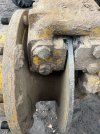
I forgot to mention that almost always only one pad wears out fully; the other is only about 1/3 worn. When I install new pads, I can usually push the pistons back in almost by hand, so it seems unlikely that the pistons are sticking. Then again only one pad wears out...

The rear brake covers were not installed after the last repair for some reason. I’ll put them back on this time.

The exhaust brake valve piston is disconnected and doesn’t work. Are these a common failure? I noticed a couple of them in the “used parts bucket.”

I’ll keep these suggestions in mind and monitor what happens now that the conditions are drier and cleaner. It’s a shame that you can only see the pad thickness when the wheel is off or oil is on the ground.
 

HarleyHappy

Senior Member
Joined
Sep 30, 2020
Messages
3,358
Location
So NH
Occupation
Welder/Mechanic
Any rotor type brake system, in that application, is going to be a hard life.
Generally there is always drag on the inside pads as when brakes are released, the outer pad springs back, if the slides and springs are good.
The inside pads on the caliper, just stop putting pressure, they don’t really spring back.
Bikes are notorious, for only using 1/3 of the inside pad, before needing new pads.
 

HATCHEQUIP

Senior Member
Joined
Oct 19, 2011
Messages
1,535
Location
VILLANOW GEORGIA
Hook a gauge up and see if after using the brakes the pressure returns to 0 probably want to leave it on and check after the system has warmed up also.
 

ugis

Active Member
Joined
Jun 20, 2021
Messages
39
Location
Europe
This is very good idea. Shouldn't be too hard to do some measures there. Thanks!
 
Top