I agree but this is also one of those "Yes, but..." statements.
I started buying lower cca batteries a few years ago too when I was told the same thing. Everything I own is 24v diesel so at least I try to match a high cca battery to my 'larger' engines. For instance, the trucks with a Cummins 8.3L I'll go with two 750-800 cca but for the Cummins NHC-250 (14L), I'll go with a pair of 1000cca for that little bit extra crank. Does it really matter for me in central Texas (today will be a high of 80F)? Probably not but it's what I do.
But after doing a lot of my own research (for my own particular job/career right now), I don't think all manufacturers are really using thicker plates that are truly more mechanically robust for lower cca batteries. I think some are just not using as many plates of the same thickness to achieve the lower cca. Here's why I think it's a mixed bag out there:
At Walmart, you can buy the EverStart Group 65 850 cca and 150 min reserve for $140 or the 650 cca with 140 min reserve for $110. Each weighs 47.4lbs so at least here I believe the plates are thicker for the 650 cca. A reduction of 200 cca but the same weight implies the same amount of lead so the plates are probably thicker by 31% in the 650 cca.
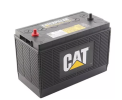
And now look at Catepillar Group 31 batts which I'm sure are very commonly used by everyone here. There are three types: General duty, Heavy Duty, and AGM (see the attached brochure).
For heavy duty, let's compare two similar group 31's with the only difference being cca and reserve. You can see the 1000cca battery is actually a pound lighter than the 825cca even though it has 21% more cranking power. This means the 825cca has less plates and they must be thicker, about 26% thicker than the 1000cca. The rule of 'lower cca = thicker plates' holds true here like the Walmart batteries.
View attachment 355469
But when you look at Cat's General Duty batteries, I think they're trying to hose us. For these the 1000 cca is 58lbs while the 760 cca is 52.5lbs. From my calculations, there really is no thickness change in the plates between the 1000cca vs 760cca. The 760cca is just a weaker battery. Here the rule breaks down.
View attachment 355468
If you want to get into the brute batts, the AGMS, here you can see a much more robust battery. The 800 cca is a full 6lb heavier than the 925 cca and has higher reserve than anything else. So, on the outside, it looks like the AGM is by far a better battery for anyone to stick in their vehicles.
View attachment 355471
But wait, remember the discussion about charging profiles where AGMs need to charge at lower voltage than flooded cells? Even in the Cat brochure it says to charge their AGMs at a lower voltage:
Alternator and charger instructions: for 12-volt AGM Batteries charge to 14.4 volts but no more than 14.6 volts at 68° F (20° C). If you don't, you're just frying your $$$ Cat AGM.
So bottom line: A lower CCA battery that weighs as much or more than a higher CCA batt in the same brand and family probably has thicker plates. If it weighs much less, it's probably just a cheaper battery. And if you toss in an AGM into the system, make sure you're charging it correctly or it may be a waste of effort.