• Thank you for visiting HeavyEquipmentForums.com! Our objective is to provide industry professionals a place to gather to exchange questions, answers and ideas. We welcome you to register using the "Register" icon at the top of the page. We'd appreciate any help you can offer in spreading the word of our new site. The more members that join, the bigger resource for all to enjoy. Thank you!

Cat 3204 overhaul - which bolts are critical to replace?

OzDozer

Senior Member
Joined
Jan 18, 2007
Messages
2,274
Location
Perth, Western Australia.
Occupation
Semi-Retired ..
So I'm tearing into the Cat 3204 that's in my Cat 931B, and I'm wondering what bolts are critical to replace?

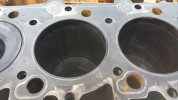
She's getting an out-of-frame overhaul with a full IPD 3-ring piston, engine kit. All new bearings and a rebore that looks like it will be .020" oversize (bore is currently standard with only a moderate level of wear, so I think .020" will take out all the wear).

I have to replace some of the head bolts (the ones behind the exhaust manifold) because of corrosion. However, I was wondering if it's necessary to replace all the head bolts, or if the remaining ones (that appear to be good) can be re-used?

I'm working on replacing all the big end bolts, I don't think it's worth the risk to re-use these in a 3200 series engine - even though this 3204 is not highly stressed at 65HP.

I've got a chunk out of the skirt of #4 piston, and cracking in the same area on #3 piston. There's a melted area on the skirt of #4 piston, which seems to indicate overheating in recent times. The cooling system is in poor shape, so I'm guessing this would have led to overheating.

The bearings are pretty moth-eaten, I don't ever recall seeing bearings that look like this. I'm thinking something in the crankcase has etched the aluminium.
The crankshaft is good, it's standard, and it doesn't even need a grind - just some linishing, and I think it'll come out just fine.
Sorry about the lack of clarity in the photos, my phone camera has seen better days, the glass is cracked over the lens.
 

Attachments

  • 931B-BORE-1.jpg
    931B-BORE-1.jpg
    104.8 KB · Views: 47
  • 931B-BORE-2.jpg
    931B-BORE-2.jpg
    60.2 KB · Views: 46
  • 931B-PISTON-No-4-BREAK.jpg
    931B-PISTON-No-4-BREAK.jpg
    149.3 KB · Views: 46
  • 931B-PISTON-No-4-MELT.jpg
    931B-PISTON-No-4-MELT.jpg
    144 KB · Views: 46

OzDozer

Senior Member
Joined
Jan 18, 2007
Messages
2,274
Location
Perth, Western Australia.
Occupation
Semi-Retired ..
Hmm, the last post would only let me put up a maximum of 4 photos. Here's some more.

All the components are genuine Cat, so I'd have to say this is the first time this engine has been stripped down since it was built in 1980. I was a little surprised at that, this tractor looks like its done at least 10,000 hrs. Undercarriage has been rebuilt, and is nearly worn right out again.
 

Attachments

  • 931B-PISTON-No-3-CRACK.jpg
    931B-PISTON-No-3-CRACK.jpg
    114.4 KB · Views: 61
  • 931B-BEARING-2.jpg
    931B-BEARING-2.jpg
    163.2 KB · Views: 55
  • 931B-CRANKSHAFT.jpg
    931B-CRANKSHAFT.jpg
    75.7 KB · Views: 60
  • 931B-SHIFT-7.jpg
    931B-SHIFT-7.jpg
    227.7 KB · Views: 57

Robert61

Well-Known Member
Joined
Oct 11, 2022
Messages
88
Location
Mississippi
Check the rod bushings. Wiggle the rod from side to side. I had 2 sets of rods, ones like yours and the early straight rods. The tapered rod bushings were worn out. The early straight rods were good and I reused them. I don’t know why manufacturers went to the tapered rods other than they say they beefed up the piston bosses. I’m not a fan of tapered rods. A friend with a motor home had a Cummins engine with tapered rod. Low mileage and it killed a bushing and kicked the rod out. I’m looking for another set of straight rods. I’m not going to use the set of tapered rods I have unless I have to.
 

OzDozer

Senior Member
Joined
Jan 18, 2007
Messages
2,274
Location
Perth, Western Australia.
Occupation
Semi-Retired ..
I've checked the little end bushings and they're in good shape. I know this is a weak area for the 3200 series - but it seems the later design, genuine Cat, tapered little end bushings, provide satisfactory service - as shown by this engine still running satisfactorily, 43 years after it was originally built.

I believe Cat went over to tapered rods to improve the piston strength, as the pistons seemed to be almost always, the weakest part of the 3200 series engine design.

Did you re-use your head bolts and big end bolts in your D3 engine overhaul?
 

Robert61

Well-Known Member
Joined
Oct 11, 2022
Messages
88
Location
Mississippi
Yes I reused mine. There’s always confusion on torque to yield and torque to angle. The torque to yield bolts I’ve seen are turned down narrower in the center. They are designed to keep a constant torque on something like a head bolt. I consider the Cat bolts to be torque to angle. Which means they are torqued to a specific angle and not until the bolt is deformed. Torque to angle bolts can be reused. When the GM LS engines cam out everyone threw the bolts away and used new ones every time. Then info cam out that they were torque to angle and could be reused. I’m sure someone will be along as usual and explain that I’m full of §¥#&. But this is my opinion along with many others and is published data.

I’ve considered rebushing the tapered rods but it’s more complicated than bushing a straight rod. Cummins had a recall on the engine series my buddy had but his serial number fell just outside of the recall. I know almost every manufacturer uses them but I don’t like them. I haven’t measured mine but just wiggling them they are the most worn out bushings I’ve ever seen.
 

Nige

Senior Member
Joined
Jun 22, 2011
Messages
38,615
Location
G..G..G..Granville.........!! Fetch your cloth.
Oz, do you have a copy of Cat's Reuse & Salvage Guideline for Threaded Fasteners.? That has a lot of useful information to answer the questions you are asking.
Neither the head or the rod cap bolts call for being thrown when removed so it's very much a case of a)Do they comply with reuse guidelines and b)Do you really want to reuse them.?
 

OzDozer

Senior Member
Joined
Jan 18, 2007
Messages
2,274
Location
Perth, Western Australia.
Occupation
Semi-Retired ..
Nige - No, I haven't got a copy of that Reuse and Salvage Guidelines for Threaded Fasteners - but I found it, and read it - thanks very much.
The booklet filled me in on a few things that I didn't know about re-using bolts. I've always used the "necking" and corrosion checks on all Cat fasteners, even in non-critical situations - but I regard the likes of big end bolts as needing special treatment.

At least with head bolts, the worst that can happen is a bolt can fracture, and you get a leak. That's fixable. But a failed big end bolt is disastrous - and I've seen my share of ventilated blocks on 3208's.

I've very rarely replaced any head bolts on any Cat engines I've rebuilt in decades past - if they passed the necking and corrosion check, I re-used them. And any Cat Field Servicemen I ever worked with, always re-used head bolts that were in good condition.

So I reckon I'll re-use the majority of the head bolts here, if they pass the checks - but I'll install all new big end bolts for peace of mind.
After all, it's only 8 bolts, and not a huge cost - but they're critical, so I like to sleep easy at night. Thanks for your input.

Dave, I'll be looking carefully at the oil pump, and probably replacing it. But I don't think the engine has been overheated that much, that it has severely affected the head bolts with temperature change.

You need a pretty high temperature to seriously affect the strength of Cat grade 8 bolts, and they show no sign of high temperature damage - apart from the corroded bolts behind the exhaust manifold, which I'm replacing, anyway.
 

OzDozer

Senior Member
Joined
Jan 18, 2007
Messages
2,274
Location
Perth, Western Australia.
Occupation
Semi-Retired ..
Yow, I just priced genuine big end bolts from my local Cat dealer (Westrac), and the bolts are AU$38 each, and the nuts are AU$12 each!! AU$400 just for 8 bolts!

Surely some other reliable bolt manufacturer produces them for a more reasonable price? I saw where IPD produce them, but I've not found anything on their bolt pricing.
I definitely don't want Chinese/Costex/Reliance bolts, in this location!
 

OzDozer

Senior Member
Joined
Jan 18, 2007
Messages
2,274
Location
Perth, Western Australia.
Occupation
Semi-Retired ..
Interestingly, I contacted the U.K.-based KMP Brand engine parts supplier with regard to new big end bolts for my 3204 - and despite them regularly claiming their products are sourced from European manufacturers - they advised me their Cat 9N3832 bolts and 9L7669 nuts, are made in India!

AFAIC, India still has a long way to go to develop a reputation as a manufacturer of high quality components, and I regard them as the equivalent quality of Chinese products of 25 years ago.
 

OzDozer

Senior Member
Joined
Jan 18, 2007
Messages
2,274
Location
Perth, Western Australia.
Occupation
Semi-Retired ..
Well, we've had some seriously deficient Cummins engine parts here that came from India, so I guess a lot must depend on the particular Indian manufacturer, and the level of QC.

In addition, the Indian Mahindra and Tatra brands of vehicles that have been sold here are providing less-than-stellar performance, and they still have a way to go to meet the quality and reliability standards of the major auto manufacturers.
 

OzDozer

Senior Member
Joined
Jan 18, 2007
Messages
2,274
Location
Perth, Western Australia.
Occupation
Semi-Retired ..
Just an update - I've bitten the bullet and purchased a full set of new IPD conrod bolts and nuts. I just don't want to risk another engine rebuild caused by just one original bolt failing, after it was re-used - even though it met Cat guidelines for re-useability.

I'm trusting that IPD have a good manufacturing source. They don't clearly state where their products are actually made.
The full Out-of-Frame gasket set I received from IPD hasn't got a big American flag on it, as I thought it would!

The IPD 3 ring pistons are still making their way here - and I've also ordered a full set of new IPD intake and exhaust valves for the cylinder head.
Surprisingly, IPD in Sydney have these in stock - but Cat have to ship them in, if I order genuine!

There wasn't a huge saving between IPD and Cat valves, about AU$10 each - but it all adds up.
I ordered new little end (wrist pin) bushings from Cat, on 12th May - and here it is, the end of May, and they still haven't arrived!

They said "5-15 days" (from Melbourne on the East Coast) when I placed the order. I think that's a pretty poor showing on Cat's behalf.
I know all shipping is still a bit slow, but if they really were in Melbourne, that's pathetic. Even if they were in Singapore, it shouldn't take any more than about 4-5 days to get them to me.

Meantimes, the cylinder head reconditioning has been an interesting exercise. I dropped the head off at a big company repair shop, and left instructions to "clean, strip and quote".
They said they were "understaffed" and it would be a week and half before they could get to it.

3 weeks later, out of the blue, with no other contact, I get an email with a repair quote of AU$2,400!!
The quote was simply for replacing EVERYTHING!!
New valves, new inserts, install thin wall guide sleeves, all new springs - nothing was salvageable, according to this quote!

Furious, I raced over to the business and asked what was the story behind the massive cost?
They immediately got very defensive. "Oh, we've checked and tested and measured everything, and it's all worn out!! Everything needs replacing!"

"Are you using Cat re-useability guidelines in your checks and repair quoting?", I asked. "This is a head from an engine that started first kick, and ran like a top!"
The answer came back - "We don't need Cat re-useability guidelines, we've been in business for 50 years, and we know what we're doing!"

"Yeah, you know what you're doing, alright!!", I retorted. Treating every client like they're a mining company, and cost is no object, just replace every single component!! Save you having to repair anything!! I can buy a complete new aftermarket head for less than AU$2400!!
Just give me the head back, and let me know what I owe you for the strip and quote!"

So, next thing, he presents me with a bill for AU$638!! For a requested strip and quote?!
I go through it, and it's got listed - 2 crack tests, 1 pressure test, all new stainless core plugs, an acid bath, a freight charge of $20, and an "environmental levy" of another $20!!

I said, "This was supposed to be just a strip and quote? But you've done a heap of tests and a pressure check, and already started installing new components!!"

"Well, we had to do all that, so we could quote!", was the reply. I didn't even ask what the freight charge was for, I was so disgusted.
So they loaded the head onto my ute, and I start to inspect it - and it still has a heap of corrosion inside the waterways!!

So much for their "acid bath"!! They dumped the head in an automated parts washer, and that warranted an "acid bath" charge!!

I took the head back to my shop and made up a citric acid bath, and dropped the head in it for 4 days.
After the 4 days, I pulled it out and pressure-washed it, and it STILL had scale around the exhaust ports!
I chiselled the scale out and I've dumped it back in the bath for another couple of days. By then, the head WILL be acid-bathed and clean!

Since then, I've found a local small reconditioner who is willing and eager to clean up the inserts and install the thin-wall bronze bushings.
No quote or estimate has been provided yet, until I drop it off to him, later this week - but I'm assured the charges won't be anything like the level of the other company! You live and learn!!

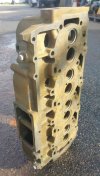
Here's a few photos of the head after the first dip in the citric acid bath, and after the pressure wash.
I tried to get a couple of photos of the scale inside the exhaust ports, but it's difficult to see it, as everything is the same colour. You can see where I've been chiselling the scale loose.

The dirty colour is just flash rusting after the pressure wash. When I'm finished, I spray the bare metal with a weak solution of phosphoric acid, and it leaves a nice phosphate coating on the metal, that protects it.
 

Attachments

  • 931B-HEAD-2.jpg
    931B-HEAD-2.jpg
    178 KB · Views: 28
  • 931B-HEAD-4.jpg
    931B-HEAD-4.jpg
    159.6 KB · Views: 28
  • 931B-HEAD-1.jpg
    931B-HEAD-1.jpg
    104 KB · Views: 28
  • 931B-HEAD-3.jpg
    931B-HEAD-3.jpg
    81.3 KB · Views: 28

Robert61

Well-Known Member
Joined
Oct 11, 2022
Messages
88
Location
Mississippi
I have been around the thin wall guides for years. I never got good service out of them. Plain cast iron guides are no better. I highly suggest using 1/2” diameter bronze guides. They don’t cost much more and installing them is the same procedure. Installing the rod bushings needs to be done by someone that knows what they are doing. They need the tool that is made specifically for these rods. They can make it but they need the tool. It keeps from collapsing the bushing installing it. The rod is supposed to be heated as well. I would be much more concerned with the tool myself.

Guides $100-150
Valve job $150
Magnaflux $40
You have new valves
Springs, I’m so leery of aftermarket parts I reused my old springs.
Resurface $75

All I can say is $2400 wow.
 
Last edited:

OzDozer

Senior Member
Joined
Jan 18, 2007
Messages
2,274
Location
Perth, Western Australia.
Occupation
Semi-Retired ..
The rod bushings are being installed by the company that has bored my block. I'm confident they know what they're doing, and they'll get a print copy of the Cat rod bushing installation instructions, just to make sure.

They're also quite reasonable with their charges - they've bored the block .020" O/S, decked it, checked the bearing tunnels for alignment (they're spot-on), linished the crankshaft and checked it for dimensions, cracks, etc, and acid-bathed all the components.

They've already provided a cost for rod bushing installation - AU$280. The total cost for all of the above is AU$1700. I'm happy with that.
The gent I'm dealing with rebuilds Cat engines regularly, so he knows the score.
He's very aware of the critical bushing clearances, and installation methods, and I'd be pretty confident he's got the necessary tools and skills to do the bushings.
They definitely heat the rod to install the bushings. To not do so, risks galling of the bushing when it's being pressed in.

The Cat instructions state the rod must not be heated over 400°F, and I've always worked on the old Cat serviceman instructions I got over 55 years ago, for bearing installation - the temperature where oil is just starting to produce boiling bubbles, is the right temperature for installing interference-fit items.

Robert61 - I'm not sure what you're referring to re poor performance from thin wall bushings for the guides. I'm planning on using thin wall bronze bushings.
Did you previously use thin wall steel bushings to get the poor wear rate?

I must say I was quite amazed by the wear in the guides in this head, a couple of the guides were worn about 2mm, I've never encountered this level of wear before in any cylinder head I've done.
 
Last edited:

Robert61

Well-Known Member
Joined
Oct 11, 2022
Messages
88
Location
Mississippi
These are what I call thin wall guides. These came out of one of the biggest builders in the US engines, this is a small block Chevrolet not a Cat engine. It had very very few miles on it. As you can see the guide is worn all of the way through on both of these guides. A friend of mine bought the car as the owner could never get it to run right and the engine was supposedly dynoed before he got it. I bored the heads for the 1/2” diameter guides and redid them. These guides are only .030 thick on the wall.


On my well worn 3204 which had previously been rebuilt around 2013 I only had 1 guide that I had to install. All of the other original guides were still good.
A93F5E57-5C6A-46D1-9225-002A5C3D67D9.jpeg
 
Last edited:
Top